
The hidden work behind every resale listing
Presto Bee Team · · 5 min read

Jump to
You have a $15 plaid flannel, size L, somewhere in a bin of roughly 1,200 items. A buyer asks for the chest, the waist, the length and the sleeve.
Nothing about that request is unfair. It is also not free. You find the bin, find the shirt, lay it flat, measure four times, and update the listing everywhere it is posted.
A recent discussion on Reddit raised the question directly: how much product information should a buyer expect a seller to provide? It is a fair question, and it does not have a one-word answer, because a resale closet is not a warehouse of identical units. Every item is its own product, photographed once, described once, sold once.
What a listing has to get right
Buying preloved online means you cannot touch the fabric, check the seams, or try it on. You are reading a stranger's description and deciding whether to trust it.
Three things are not negotiable, and they are the ones a seller can state without leaving their desk: the size on the label, the fabric on the care tag, and any wear or damage that would change your mind. An item listed as linen that arrives as polyester is not a matter of taste. It is wrong, and it should be put right.
Those three are the floor. Measurements are a different kind of thing.
Measurements: necessary, or a service?
For one buyer, "size medium" settles it. For another, nothing short of a chest measurement will do, and in secondhand that instinct is well earned: vintage sizing runs differently from modern sizing, cotton shrinks, and two shirts labelled L can be three inches apart across the chest.
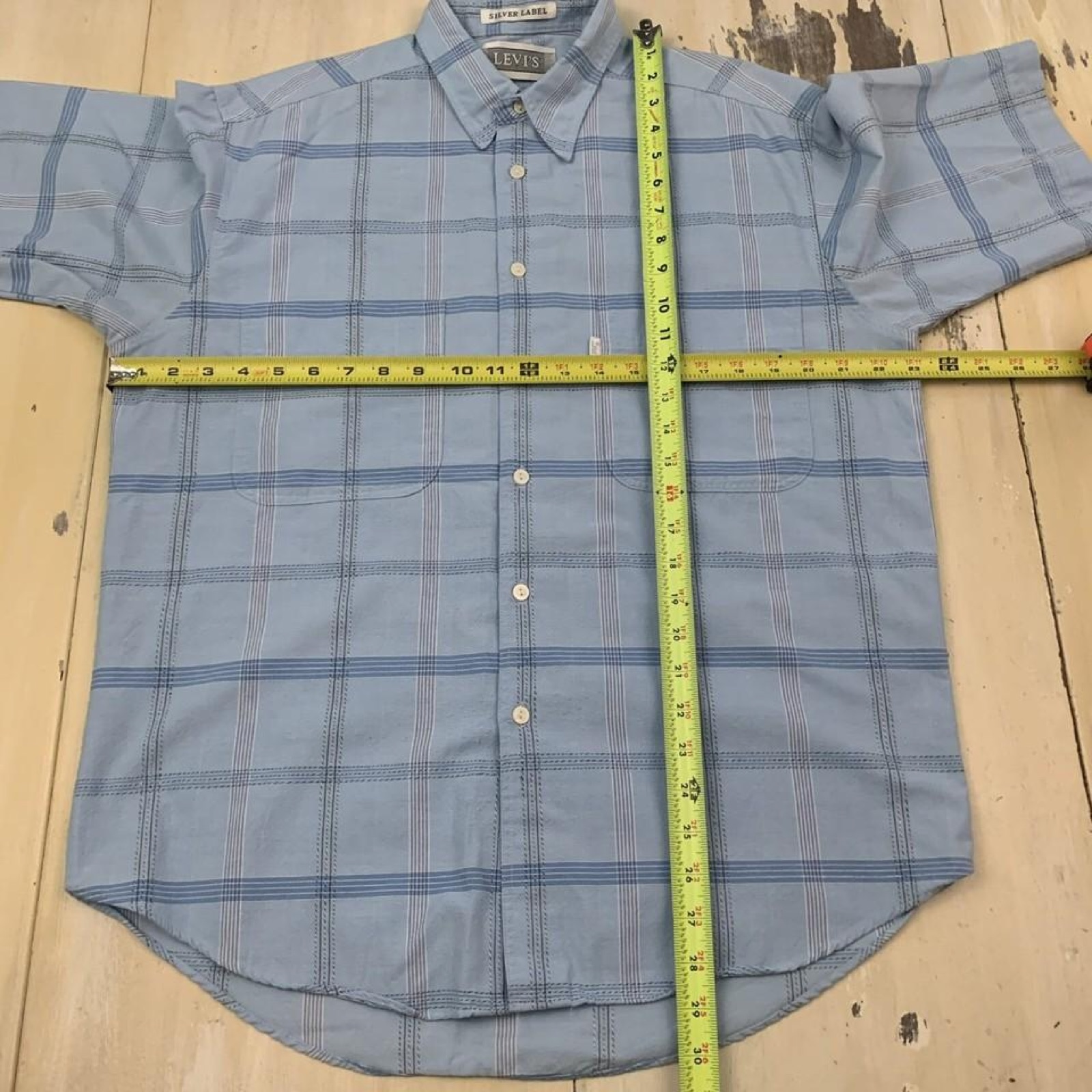
Here is the part that is invisible from the buyer's side. Time yourself doing the flannel properly: pull the bin, lay the shirt flat, measure chest, waist, length and sleeve, type them in. Call it four minutes. At four minutes an item, a 1,200-item closet is 80 hours of measuring, which is two full working weeks before a single new item is sourced or photographed.
That arithmetic is worth running on your own numbers rather than taking ours: count what is in your closet, time one item honestly, and multiply. The answer decides whether upfront measurements are a habit or a case-by-case favour for you.
None of that is an argument against asking. A seller who measures an item for you spends four minutes on one buyer and gets a buyer who knows what they are ordering. It is an argument for naming the difference between the information a listing owes you and the information someone goes and fetches for you.
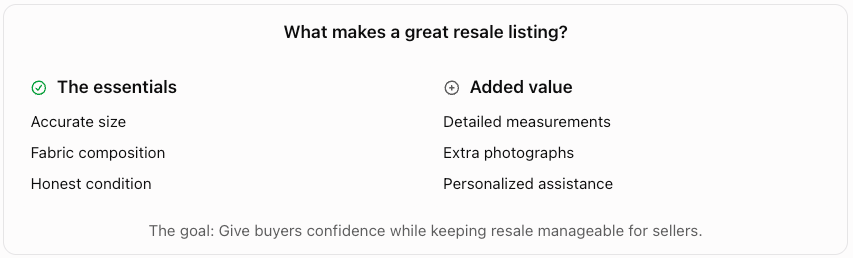
For categories where sizing is genuinely unpredictable, vintage denim and anything tailored, putting the measurements in the listing up front is usually the better business decision anyway. It is not about generosity. It is that the measurement you skip becomes a question you answer later, or a return you pay for.
The work a buyer never sees
A listing is a few photos, some text and a price. Everything that produced it happened somewhere else.
Someone drove to the estate sale, dug through the racks, washed the shirt, checked the seams under a lamp, shot it in decent light, looked up what three comparable ones sold for, and put it in a numbered bin so it can be found again in four months.

When the flannel sells, the work restarts: find bin 41, check the item against the order, wrap it, print the label, drop it off. Meanwhile new inventory is waiting to be listed and yesterday's buyer questions are waiting to be answered. For most resellers this is one person doing all of it, between a job and the rest of their life.
Saying so is not a request for lower standards. It is the reason a polite question gets a faster answer than a demand.
Using AI does not mean a seller never looked
The worry about AI listings is reasonable in one specific form: a description full of details nobody verified. Fabric guessed from a photo, measurements invented, a flaw that no one checked for.
The distinction worth holding is between AI that drafts and AI that invents. Drafting a title and a description from the details a seller enters saves the twentieth round of writing the same paragraph. Asserting the fabric content of a shirt nobody read the tag on is a false claim with a machine's name on it.
That is why Presto Bee's generated titles and descriptions land in the listing form for the seller to read and change before anything is published, rather than posting on their own. The sourcing, the inspection, the measuring and the packing are untouched by any of it. What gets cheaper is the typing.
Good sellers are not flawless. They are accountable.
Mistakes happen at volume. A care tag gets misread, a size gets typed wrong, a small stain goes unnoticed under bad light.
What separates a seller worth buying from one who is not is what happens next. If an item arrives materially different from its description, message the seller first with photos, and use the marketplace's dispute process if that goes nowhere. Every marketplace sets its own window for raising a problem after delivery, so check yours and do it early rather than after it closes.
Buyers have cheap defences too: read the seller's ratings, look at what other buyers said, zoom into the photos, ask before you buy rather than after.
Where better tools actually help
The useful question is not whether buyers ask too much or sellers do too little. It is how much of the seller's day is spent re-typing the same item into four different forms.
That is the specific problem Presto Bee works on. One item gets entered once and cross-listed to Poshmark, Mercari, Depop and eBay, and the listing work is managed from one place instead of four tabs. The time that gives back is the time a seller can spend on the parts that need a human: checking the tag, measuring the chest, answering the question.
What this asks of both sides
Buyers are owed an honest listing: the real size, the real fabric, the real condition. That is the floor, and a seller who cannot meet it should not be selling the item.
Measurements are a service on top of that floor. Asking for them is reasonable. So is recognising that the person fetching them is finding one shirt among 1,200 for a $15 sale, and that four minutes multiplied by a closet is two working weeks.
FAQ
Should sellers put measurements on every listing?
Not necessarily, but for vintage, tailored or anything with unpredictable sizing it is usually worth it. Measuring an item takes a few minutes, which is manageable for one listing and significant across a thousand. The measurement you leave out tends to come back as a question or a return.
Is it rude to ask a seller for measurements?
No. Ask for the specific measurements you need rather than all of them, and expect that the seller may have to find the item in storage first. A seller who does not want to is entitled to say so, and that is useful information before you buy.
Does an AI-written description mean the seller never examined the item?
Not on its own. AI that drafts a title or a description from details the seller entered is a writing shortcut. AI that states a fabric, a measurement or a condition nobody verified is a false claim, and the seller is responsible for it either way. If a listing reads oddly generic, ask a specific question about the item before buying.
What should I do if an item arrives different from the description?
Message the seller first with photos, and do it early: every marketplace sets its own window for raising a problem after delivery. If that does not resolve it, open the dispute process on the marketplace you bought through. A genuine mistake is usually fixed quickly, and a seller who refuses to engage is telling you something about the next purchase.
For smarter reselling
Know your profit. Grow your sales.
Get practical reselling tips, marketplace fee updates, and free tools to keep more of what you earn.
Free insights. No spam. Unsubscribe anytime.